Best AV Receiver Under 500 (2026): Two Picks and Who Should Skip Each
Receivers and amps
Under $500 you are choosing between a surround receiver that passes 4K at 120Hz and a stereo receiver that just sounds better than your TV. Both are good answers, and the wrong one is expensive to undo.
Our picks
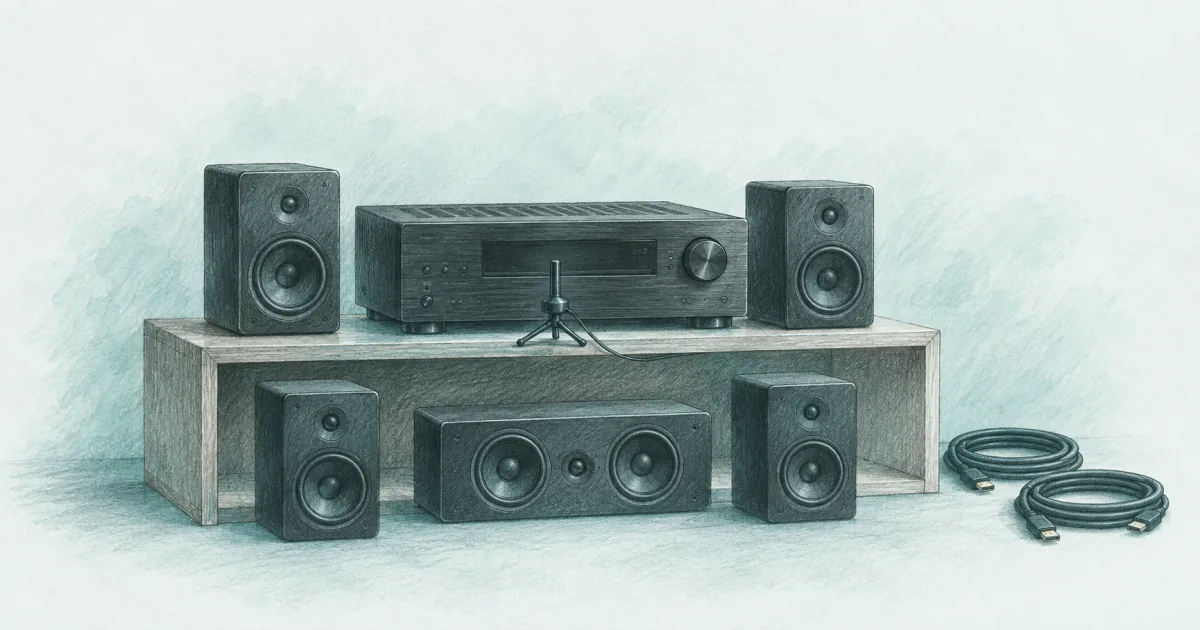
The best AV receiver under $500 is the Denon AVR-S570BT. It passes 4K at 120Hz on all four HDMI 2.1 inputs, hands audio back to the TV over eARC, and walks you through speaker setup with an on-screen assistant and a microphone in the box. The Sony STRDH190 is the other honest answer: a two channel stereo receiver that beats a soundbar for music and takes a turntable directly.
These two are not really competitors. One is the front door to a surround system. The other is the cheapest way to make two good speakers sing, with no interest in rear channels.
If the surround question is already settled against a receiver, our soundbar guide covers when a bar is genuinely enough, and the receivers and amps guides collect the rest of the chain. If you are building around vinyl, the turntable guide covers which decks include their own phono stage.
What to check before you buy either one
The video section is the first filter. If a console is part of the plan, the receiver must pass 4K at 120Hz, not just 4K. Plenty of budget receivers list 4K and then cap the signal at 60Hz, which silently downgrades a current console. HDMI 2.1 on every input, plus VRR and ALLM, is what you are looking for.
The second is eARC. It lets the TV send uncompressed audio back to the receiver over one cable, which means you do not need a separate optical run for the good formats. Almost every receiver above the bargain bin has it, but the wording varies, and our HDMI cable guide covers what the link needs to carry.
The third is what you are amplifying. A receiver is only as good as the speakers it drives. If you already own two speakers you like and no plans for rear channels, a stereo receiver does the job better for a third of the price. If you own nothing yet, price the speakers before you price the receiver, because a $400 receiver into $80 speakers is backwards.
Then decide on room correction. It is the feature that separates a receiver that sounds fine from one that sounds right in your room. The Denon includes Audyssey with a microphone; a stereo receiver has nothing, because with two speakers and a proper listening position there is less to correct.
The best surround receiver under $500: Denon AVR-S570BT
The Denon AVR-S570BT is the pick for anyone building a real surround system. It is a 5.2 channel receiver with 70 watts per channel into 8 ohms across the full frequency range, which is enough for a normal living room with reasonably efficient speakers.
The video side is where it earns the money. All four HDMI inputs are HDMI 2.1, so 4K at 120Hz, 8K at 60Hz, VRR, ALLM, and Quick Frame Transport pass through whichever input you use. HDR10+, Dolby Vision, and Dynamic HDR are all supported, and eARC handles the return audio at up to 40 Gbps. In plain terms, one cable to the TV and the receiver becomes the switch for everything else.
Setup is deliberately friendly. The on-screen assistant asks what speakers you have, where they are, and then runs a calibration sweep with the included microphone. Owners describe the process as intuitive and the result as accurate enough to leave alone, with manual tweaks available if dialogue still feels quiet.
The limits are worth knowing. There is no Dolby Atmos and no physical height channel support, so this is a 5.1 or 5.2 receiver rather than a 3D audio one. There is no Wi-Fi and no HEOS, so streaming is Bluetooth only, and the Bluetooth receiver takes audio in but cannot send it out to headphones. A turntable needs its own preamp, because there is no phono input.
The volume ramp is the one daily annoyance. It climbs slowly and then jumps, so small adjustments are easier on the Denon remote.
See the Denon AVR-S570BT on Amazon for the current price.
The best stereo receiver for music and records: Sony STRDH190
The Sony STRDH190 is the pick when surround sound is not the goal. It is a two channel stereo receiver rated at 100 watts per channel into 8 ohms, and it costs about the same as a mid-range soundbar.
The phono input is the feature that matters for a lot of buyers. It has a dedicated phono stage and a ground terminal, so a turntable plugs in directly and plays at the right volume without a separate preamp box. Four stereo RCA inputs, a 3.5 mm input on the front, and Bluetooth cover everything else, and there is a full size quarter inch headphone jack for late nights.
The build is quiet and simple. The chassis is 5.25 inches tall, so it slides into a standard AV shelf without a fight, and the power transformer is the part doing the work for clean output at normal listening levels. A/B speaker switching lets you run one pair, the other pair, or both at once, which is the cheapest way to get music into a second room.
What it will not do is decode surround. It has no center channel, no rear channels, no Dolby Atmos, and no HDMI at all, so a TV connects over optical or analog rather than HDMI. Sony's 145 watt figures are quoted at 6 ohms and 1kHz, which is not comparable to the Denon's full-bandwidth 8 ohm rating. If you want movies to come from behind you, this is the wrong box.
See the Sony STRDH190 stereo receiver on Amazon for the current price.
Which receiver fits your room
Buy the Denon if you are building toward five speakers and a subwoofer, if a console or a 4K at 120Hz source is in the chain, or if you have more HDMI devices than your TV has ports. The receiver replaces the TV as the input switcher, and that alone solves a lot of daily annoyance.
Buy the Sony if you own two good speakers, if a turntable is part of the plan, or if the TV sits in a room where five speakers would be furniture. It is also the better music machine, because two channels of clean power into good speakers beats a budget five channel receiver spreading the same money across more amplifiers.
Buy neither if a soundbar already solves the problem. A bar is simpler, needs one cable, and fills a small room. The receiver wins when the room is bigger, the speakers are better, or the system has to serve more than the TV.
What to skip at this price
Skip Dolby Atmos at this budget unless you step up to seven channels. A 5.2 receiver cannot power height speakers, and virtual height processing is a texture, not a ceiling speaker. If Atmos is genuinely the goal, save longer rather than buying a 5 channel box and hoping.
Skip the biggest wattage number on the box. Power is quoted at different loads and frequencies, so a 70 watt receiver rated across the full band can outperform a 145 watt figure measured at 1kHz. Speaker sensitivity decides how loud your system actually gets.
Skip a receiver with no room correction if you can afford one that has it. In a normal living room with one couch, one subwoofer position, and a TV between the front speakers, automatic calibration fixes problems you cannot hear by ear.
And skip buying speakers last. The order that works is speakers, then receiver, then subwoofer. Pick the receiver to match the speakers you want, not the other way around, because a good pair of speakers on a modest receiver will sound better than the reverse for years.
Frequently Asked Questions
What is the best AV receiver under 500?
The Denon AVR-S570BT is the best AV receiver under $500 for most people. It is a 5.2 channel receiver with four HDMI 2.1 inputs that pass 4K at 120Hz and 8K at 60Hz, eARC for lossless audio from the TV, and a guided on-screen setup with an included calibration microphone. It sells around $449. If you do not want surround sound at all, the Sony STRDH190 is a two channel stereo receiver for closer to $200.
Do I need an AV receiver if I already have a soundbar?
No. A soundbar is the right answer for one room and one TV, and it costs less for the same improvement over TV speakers. A receiver earns its place when you want real speakers in real positions, when you are bringing a turntable or a pair of good bookshelf speakers into the system, or when you have more HDMI devices than the TV has inputs.
What is the difference between 5.1 and 5.2 on a receiver?
The first number is how many speakers plus which positions, and the second is how many subwoofers. A 5.1 system is left, center, right, two surrounds, and one subwoofer. A 5.2 receiver adds a second subwoofer output, which is useful because two smaller subs in different spots usually sound smoother than one big one in a corner.
Will a receiver pass 4K at 120Hz from a console?
Only if the receiver supports HDMI 2.1 on the input you use. A lot of budget receivers advertise 4K but quietly pass it at 60Hz, which caps a PlayStation 5 or Xbox Series X. The Denon AVR-S570BT has HDMI 2.1 on all four inputs, so any of them handles 4K at 120Hz with VRR and ALLM.
How much power do I need for a home theater receiver?
Less than the box suggests. Power ratings are quoted at different loads, so a receiver rated at 70 watts into 8 ohms across the full frequency range can drive a normal room as well as one rated at 145 watts at 6 ohms and 1kHz. Speaker sensitivity matters more than the wattage number, and a subwoofer takes the low end off the amplifier's plate.
Can I use a receiver with a turntable?
Yes, and that is one of the best reasons to buy one. You need a phono input, either on the receiver or in the turntable. The Sony STRDH190 has a dedicated phono input with a ground terminal. The Denon AVR-S570BT does not, so a turntable would need its own preamp or a deck with one built in. Our turntable for beginners guide covers the versions that solve this for you.
Does the Denon AVR-S570BT support Dolby Atmos?
No, and that is the main thing to know before buying it. It decodes Dolby TrueHD, DTS-HD Master Audio, and DTS Neural:X virtual height, but it cannot power physical height or ceiling speakers. If Atmos is the goal, you need a 7 channel receiver, which usually starts above $500.
How long should an AV receiver last?
A good one runs eight to twelve years. Receivers age out on features rather than failure: HDMI standards move, streaming services change, and room correction improves. Buy one step above what you need today if you plan to keep it a decade, and make sure the video section supports the refresh rate your next console will want.