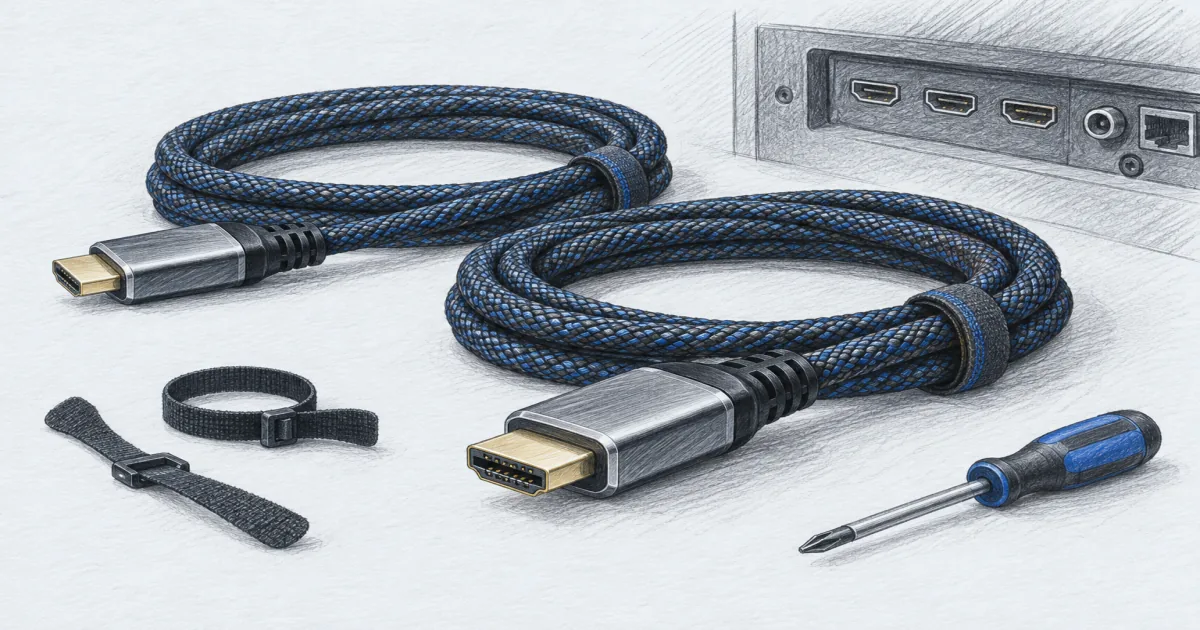
Best HDMI Cable (2026): What to Buy and What to Skip
Mounts, cables and seating
Most HDMI cables are the same cable. The ones worth buying carry the HDMI Forum certification and stay short enough to hold full speed, and there are two we would actually spend money on.
Our picks
The best HDMI cable for most setups is the UGREEN 8K HDMI 2.1. It is a certified 48Gbps cable at 6.6 ft, which is the length that covers a console, a streaming box, or a soundbar without pushing passive copper past its comfort zone. The Highwings 8K HDMI 2.1 2-Pack is the pick when two devices need cables on the same day.
HDMI cables are the one part of a home theater where the smart move is to stop shopping early. The signal is digital, so the picture is identical whether the cable cost $8 or $80. What changes is whether the cable actually holds full speed, and that comes down to certification and length, not branding.
If you are still choosing the gear on the other end, our soundbar under $500 guide and the wireless surround sound guide cover the audio side. The cables and seating guides page collects the rest of the pieces that finish a room.
What actually matters in an HDMI cable
The first number is bandwidth. HDMI 2.0 tops out at 18Gbps, which is enough for 4K at 60Hz and no more. HDMI 2.1 runs at 48Gbps, and that is what pays for 4K at 120Hz, 8K at 60Hz, variable refresh rate, and uncompressed Atmos over eARC. If a cable is not rated for 48Gbps, it is not an HDMI 2.1 cable no matter what the box says.
The second thing is the certification label. The HDMI Forum runs a testing program for Ultra High Speed cables, and certified ones carry a holographic mark with a QR code that resolves in the Forum's database. Only cables that pass third-party testing get to print it. That matters most in a multi-device setup where HDR, VRR, and high refresh rates all compete for the same link, because a marginal cable fails there first.
The third is length. At 6.6 ft, every certified 48Gbps cable works. Around 10 ft, quality starts to matter. Past roughly 15 ft, passive copper runs out of headroom and you should switch to an active or fiber cable. A long passive cable that "works" will often cap itself at 4K at 60Hz without telling you.
The best HDMI cable for most setups: UGREEN 8K HDMI 2.1
The UGREEN 8K HDMI 2.1 is the cable to buy when you want one lead that will not become the reason something looks wrong. It carries 10K and 8K at 60Hz, 4K at 240Hz for PC setups, dynamic HDR for HDR10+ and Dolby Vision, VRR and auto low latency mode for consoles, and eARC for uncompressed audio back to a soundbar or receiver.
The build is a step above the plain molded cables. The connectors are machined zinc alloy with gold-plated pins, the jacket is braided nylon, and the whole thing is shielded well enough that a busy receiver cabinet does not bother it. It also supports the full HDMI 2.1 feature set at once, which is the real test: HDR plus VRR plus 4K at 120Hz is a bandwidth-heavy combination, and that is exactly where cheap cables develop manners problems.
The honest limit is the length and the jacket. At 6.6 ft it is ideal for a console, a streaming stick, or a soundbar sitting near the TV. If your run is longer, this is the wrong shape of cable, and no amount of quality fixes physics. The stiffer braid also shows up if you are threading it through a narrow in-wall plate or a sealed cabinet grommet.
See the UGREEN 8K HDMI 2.1 on Amazon for the current price.
The best value if you need two: Highwings 8K HDMI 2.1 2-Pack
The Highwings 8K HDMI 2.1 2-Pack solves the most common setup problem: you buy one good cable, then realize the soundbar, the streaming box, and the console all want one too. Two certified 48Gbps cables in 6.6 ft cover a console and a soundbar, or a receiver and a projector, for less than many single cables cost.
Performance is the same 48Gbps the pricey cables claim. That means 4K at 120Hz with HDR, 8K at 60Hz, VRR for consoles, and eARC audio in one link. Owners who run several of them across a house report they simply work, which is a low bar that a lot of cheap cables fail. Amazon has the two-pack at about 10 percent off right now, which is a normal sale price rather than a reason to panic buy.
The trade is length and flexibility. Both cables are 6.6 ft, so a wall-mounted TV with a console on a side cabinet may need a longer cable for one of the two devices. If you need one long run and one short run, buy a single long certified cable and one of these for everything nearby.
See the Highwings 8K HDMI 2.1 2-Pack on Amazon for the current price.
How long should your HDMI cable be
Measure the run, not the room. A console on a media shelf under the TV usually needs 3 to 6 ft once you account for the bend radius and a little slack. A wall-mounted TV with a cabinet off to the side can hit 10 ft or more, because the cable has to travel down the wall, around the bracket, and across the gap.
Match the cable to that number. At 6.6 ft, any certified 48Gbps cable works. At 10 ft, stay with a certified cable and check that the TV still reports 4K at 120Hz after you plug it in. Past 15 ft, use an active or fiber cable: a passive copper cable at that length will often negotiate down to 4K at 60Hz and hide the fact that HDR and VRR are gone.
Leave slack, but not a coil. A tight bend right at the connector is the most common way people damage a cable, and a wall-mounted TV puts its own weight on the port over time. Route the cable so the connector sits square in the port, then clip the slack.
Who should skip a premium HDMI cable
Skip the premium cable if everything in your chain is HDMI 2.0. A 4K TV that tops out at 60Hz, an older receiver, and a streaming stick cannot use 48Gbps, so a basic certified cable at the same length does the same job. You are paying for headroom you will never touch.
Skip the long passive cable if the run is over 15 ft. This is the mistake that generates most of the "my cable is fake" threads, and the fix is a different class of cable rather than a different brand. Active and fiber cables cost more because they contain a chip that regenerates the signal.
Skip the upgrade if you already own a certified 48Gbps cable that works. Cables do not wear out from sitting behind a TV, and a cable that currently delivers 4K at 120Hz with HDR and Atmos has nothing left to prove. Spend the money on the screen or the sound instead.
Frequently Asked Questions
What is the best HDMI cable in 2026?
The UGREEN 8K HDMI 2.1 in 6.6 ft is the best HDMI cable for most people. It carries the full 48Gbps and the HDMI Forum Ultra High Speed certification, which is the mark that proves a cable was third-party tested for 4K at 120Hz, 8K at 60Hz, HDR, and eARC. The Highwings two-pack is the better value if you need two cables.
Do expensive HDMI cables give a better picture?
No. Digital signals either arrive or they do not, so a working 48Gbps cable and a pretty 48Gbps cable deliver identical pixels. What you pay extra for is certification, build quality, and a jacket that survives being bent around a stand. Past about $15 for a 6 ft certified cable, you are buying feel, not picture.
What is the difference between an HDMI 2.0 and an HDMI 2.1 cable?
Bandwidth. HDMI 2.0 runs at 18Gbps, which is enough for 4K at 60Hz. HDMI 2.1 runs at 48Gbps, which is what 4K at 120Hz, 8K at 60Hz, variable refresh rate, and uncompressed eARC audio need. Any cable sold as Ultra High Speed is a 2.1 cable, and it will still work fine on an older 2.0 television.
How long can an HDMI 2.1 cable be?
For passive copper, stay at 6.6 ft to about 10 ft. Beyond roughly 15 ft the cable starts losing the full 48Gbps, and the symptom is not an obvious failure. It shows up as a black screen for a second, a dropped handshake, or a console quietly falling back to 4K at 60Hz. Longer runs need an active or fiber cable.
Do I need a certified HDMI cable?
Yes if you are running 4K at 120Hz or eARC audio. The HDMI Forum certification program puts an Ultra High Speed label with a QR code on tested cables, and you can scan it to check the cable against the Forum database. Uncertified cables often work at lower speeds but fail the moment HDR, VRR, and high refresh rates compete for bandwidth.
What cable do I need for a soundbar with eARC?
A certified 48Gbps cable in 6.6 ft. eARC sends uncompressed Dolby Atmos and DTS:X from the TV back to the bar, and that audio shares the same HDMI link as the picture. A short certified cable removes the cable as a suspect when dialogue drops out or the bar loses the handshake between inputs.
Is HDMI 2.2 worth buying yet?
Not for most rooms. HDMI 2.2 raises the ceiling to 96Gbps and is aimed at 12K and 480Hz hardware that barely exists in 2026. If you are buying a cable for a television or console you own now, a certified 2.1 cable covers everything it can output. Buy 2.2 later when the source device needs it.
Which HDMI cable do I need for a PS5 or Xbox Series X?
A certified 48Gbps cable of 6.6 ft to 10 ft. Both consoles use 4K at 120Hz with VRR and HDR on supported TVs, and all of that runs through one HDMI link. If the cable that came in the box is long enough and certified, keep it. If you need a longer run to a wall-mounted TV, buy a certified one and check the mode after install.