Best Projector Screen (2026): Fixed Frame, Pull-Down, or Sheet
Projectors and screens
A projector screen is the surface every projector is judged against, and the type you buy matters more than the brand. Two picks cover the ends that matter most: a 120-inch fixed frame for a dark room and a foldable sheet that costs less than a streaming stick.
Our picks
The best projector screen for most dedicated rooms is the Silver Ticket STR Series 120. A fixed frame holds the surface perfectly flat, which is the single biggest factor in how sharp a projected image looks, and the 120-inch size suits a room with 10 to 13 feet of seating distance. The Mdbebbron 120 inch foldable screen is the opposite end of the category, and the right answer for occasional use.
The screen is the part of a projection setup people buy last and regret first. A projector can only look as good as the surface it lands on, and every bump, seam, and sheen on a wall shows up as a shadow line across the picture. Screens fix that, but the type you pick matters more than the brand.
If you are still choosing the projector itself, our projector for outdoor movies guide is the place to start, and the gaming projector guide covers input lag and refresh rate. The projectors and screens guides page collects the rest.
Fixed frame, pull-down, or a hanging sheet
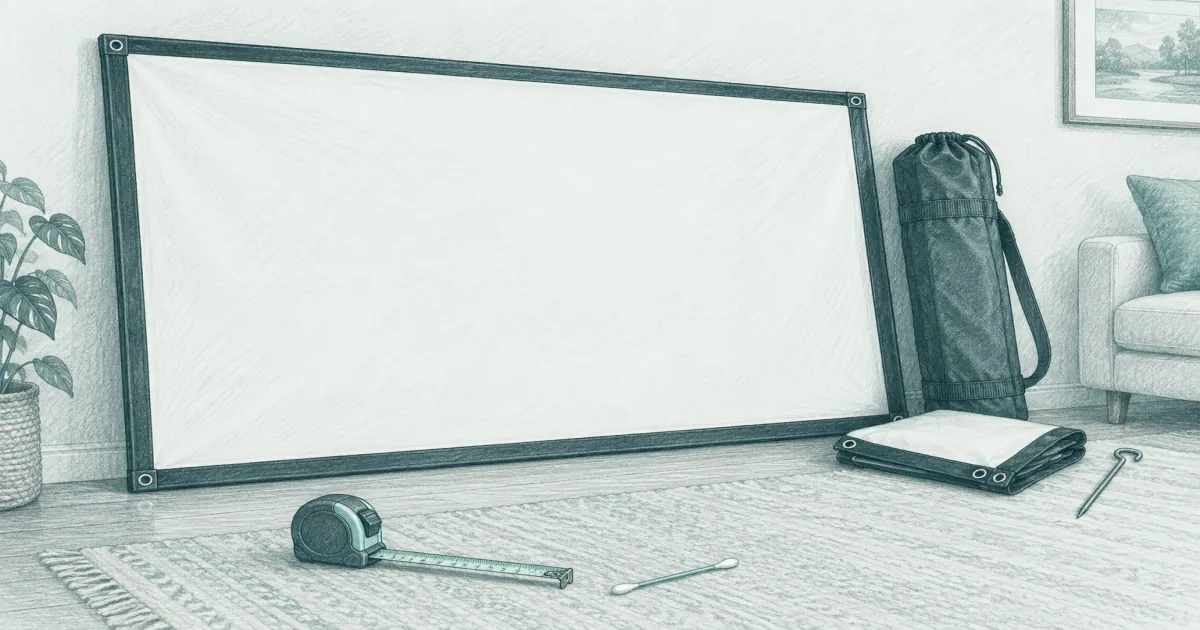
A fixed frame is the best picture per dollar in a room that can host one. The material is stretched over a rigid aluminum frame with a tension system, so the surface is flat and stays flat. The black velvet border is doing quiet work too: it absorbs light that misses the screen, which makes the image look like it floats and hides small projector alignment errors.
A pull-down or motorized screen trades some flatness for a screen that disappears. That is the right call in a multi-use room where a white rectangle cannot live on the wall. The trade is real: retractable screens can develop waves over time, and the tab-tensioned versions that avoid it cost more than a fixed frame of the same size.
A foldable sheet is the cheap and portable end. It hangs from grommets, hooks, or tape, folds into a bag, and costs about as much as a takeout dinner for four. It is not as flat as a frame and it cannot fight a bright room, but for a few backyard nights a season it is the sane choice.
The best projector screen for a dark room: Silver Ticket STR Series 120
The Silver Ticket STR Series 120 is the screen to buy when the room is dark and the screen is staying. It is a 120-inch 16:9 fixed frame with a 1.1 gain matte white surface and a 160-degree half-gain cone, which means the people on the ends of the couch see roughly the same brightness as the person in the middle.
The tension rod system is what separates it from cheap frames. Rather than gluing the material down, the frame uses rods fed through the screen edges and hooked to the frame with clips, plus a center support bar that stops sagging. The result is a flat, wrinkle-free surface that does not need readjusting every few months, and a black velvet border that improves perceived contrast by giving your eye a black reference.
The trade is the install and the material limits. Plan on a two-hour build in a space big enough to lay out a nine-foot frame, with a second person for the lift. The matte white surface is not acoustically transparent, so speakers cannot live behind it, and it is not an ambient light rejecting screen, so a room with open windows will wash it out. One more detail for console owners: some ultra short throw projectors are not compatible with this frame, so check that before ordering.
See the Silver Ticket STR Series 120 on Amazon for the current price.
The best budget screen: Mdbebbron 120 inch foldable
The Mdbebbron 120 inch is the screen for the nights when setting up a frame is not happening. It is a 120-inch 16:9 sheet with a 104 by 58 inch viewing area, made from anti-crease polyester that folds down small, and it hangs from grommets with the included hooks and ropes or with tape.
Two things make it better than a bedsheet and worth the money. The first is the weave: polyester relaxes the folds it gets in storage, so the black border straightens into a rectangle once you tension the corners. The second is that it is double sided, which means a backyard setup with the sun in the wrong place can rear project instead of moving the whole party.
The limits are flatness and light control. It hangs, so it never gets as flat as a frame, and the best results come from adding your own tape or building a simple frame for it. It also has no light rejection at all, which is fine for evenings and useless in a bright room. At this price, that is a fair set of compromises for a screen you can carry in one hand.
See the Mdbebbron 120 inch on Amazon for the current price.
How big should a projector screen be
Work backward from where people sit. A 120 inch 16:9 screen is about 104 inches wide, and a seating distance of 10 to 13 feet gives most people a comfortable cinema feel at roughly a 36 to 40 degree viewing angle. Sit much closer and the image fills your vision, which is immersive with 4K and less pleasant with 1080p.
Then check the wall and the room. A 120 inch fixed frame is more than nine feet wide and over five feet tall, so it needs a wall segment that size with nothing on it. Measure the space and not the idea of the space, because a frame that overhangs a doorway looks worse than a 100 inch screen that fits.
Finally, math the size against the projector. A projector with a 1.5:1 throw ratio needs about 13 feet of room depth for a 104 inch wide image, while a short throw at 0.5:1 needs a bit over four feet. If the room is short, a smaller screen keeps the projector inside its throw range, and our short throw guide covers the projectors built for tight rooms.
Who should skip a fixed frame screen
Skip the fixed frame if the room has to do two jobs. A wall-mounted screen takes that wall, and a living room that also needs to look like a living room may be better served by a pull-down or motorized screen that disappears. The trade is flatness and money, since tab-tensioned retractables cost more than a fixed frame of the same size.
Skip it if you cannot control the light. A matte white screen at 1.1 gain has no defense against a bright window or an overhead fixture, and it will look worse than a television in those conditions. Section off the room or move the setup before you spend the money on a screen.
Skip it if you move often. A nine-foot frame does not travel well, and a fixed screen is the kind of thing you leave for the next owner. A foldable screen or a smaller portable setup is the better fit for anyone who might change apartments next year.
Frequently Asked Questions
What is the best projector screen in 2026?
The Silver Ticket STR Series 120 inch is the best projector screen for a dedicated dark room. It is a fixed frame with a 1.1 gain matte white surface, a tension rod system that keeps it flat, and a black velvet border that makes the image look borderless. If you need something portable or cheap, the Mdbebbron 120 inch foldable screen is the practical pick.
Is a projector screen better than a white wall?
Yes, once the wall has any texture or color. A matte white screen with a gain near 1.0 reflects light evenly, while paint sheen and drywall texture create hot spots and faint shadows that move with the image. A screen also gives you a defined border, which improves perceived contrast because your eye judges the picture against black instead of the room.
What projector screen material is best?
For a dark room, matte white at 1.0 to 1.1 gain. It keeps colors neutral and viewing angles wide, which matters when more than one person is watching. Grey material helps in a room with some light because it deepens blacks, at the cost of some brightness. Ambient light rejecting material is a different job, and it only works at its best with the right projector type and screen shape.
Do I need an ambient light rejecting screen?
Only if the room has light you cannot control. ALR screens are built to reject light arriving from a specific direction, which makes them work with a bright living room or an ultra short throw projector firing up at a steep angle. In a room with curtains and lights that dim, a plain matte white screen gives you better color accuracy for less money.
What size projector screen should I buy?
Size follows seating distance, not the other way around. A 120 inch 16:9 screen is about 104 inches wide, and 10 to 13 feet of seating distance is comfortable for most people. Sit closer and the image gets immersive but the pixel structure starts to show on a 1080p projector. The room also has to fit the screen: a 120 inch fixed frame is over nine feet wide.
Can you use a fixed frame screen with a short throw projector?
It depends on the screen and the projector. A standard short throw at about 0.5:1 works with a matte white fixed frame, and many owners pair them. Ultra short throw is fussier, because the screen has to be built for light arriving from below, and some fixed frames are not compatible at all. Check the screen's own compatibility notes before you buy if the projector sits on the console.
How far should you sit from a 120 inch screen?
Around 10 to 13 feet for a comfortable cinema feel. That distance gives roughly a 36 to 40 degree viewing angle, which is the range most home theaters aim for. If your couch is closer than about 9 feet, a 100 inch screen will look sharper and feel less overwhelming than a 120.
Is a foldable projector screen worth it?
Yes for occasional use, and only that. A foldable polyester screen gives you a soft, flat surface that beats a bedsheet or a textured wall, and it packs away in a minute. What it cannot do is stay perfectly flat forever or fight a bright room. If movie night happens weekly and the room can host a permanent screen, a fixed frame is the better long-term buy.