Best Portable Projectors (2026): Mini Picks for Bedroom and Backyard
Projectors and screens
Four mini projectors that earn a spot in a small room: a 1080p Roku-first pick with a gimbal stand, an under-$100 mini, an under-$50 ceiling projector, and an under-one-pound travel unit.
Our picks
The best portable projector for a bedroom, dorm, or small apartment is the Aurzen Roku TV D1R air. It is native 1080p, and it puts the Roku interface inside the projector, so setup is one account and a Wi-Fi password instead of a dongle hunt.
The HAPPRUN Roku TV Mini is the pick if you want to stay under $100, the Magcubic HY300PRO is the value pick at under $50, and the Aurzen Roku TV E1R is the one to pack for a trip.
If you are comparing this with a full-size unit, the projector buying guides cover the bigger options, and the outdoor movie projector guide is the place to go if the plan is a backyard screen. Pair any of these with the right surface, and our projector screen guide explains what actually helps. For tight rooms, the short throw projector guide shows how to get a big image from a few feet away.
What makes a portable projector worth carrying
A portable projector trades brightness for size, and that is the whole deal. The units here run from under a pound to just over two and a half pounds, which means you can move one from the bedroom to the living room, or into a bag, without a second thought. The cost is light output, so a dim room is not a preference, it is the requirement.
The other thing that changed recently is streaming. A few years ago a mini projector was a screen and an HDMI port, and you brought the streaming stick. Now several models ship with Roku or Android built in, which removes a device, a remote, and a power brick from the setup. That single change is why these are finally easy to recommend.
Resolution is the last fork. A 1080p mini looks sharper on text and detailed scenes, and it costs a little more. A 720p mini is fine for cartoons, casual shows, and a movie before bed, and it costs less than dinner. Match the resolution to how picky you are, not to the spec sheet.
Best overall: Aurzen Roku TV D1R air
The Aurzen Roku TV D1R air is the best portable projector for most rooms because it does not make you choose between picture and convenience. It is native 1080p and rates 300 ANSI, which is the brightest and sharpest of the picks at this size. Roku TV is built in, not sideloaded, so the apps, the search, and the remote all work the way they do on a Roku TV. You are not buying a projector and a streaming stick and then finding two remotes.
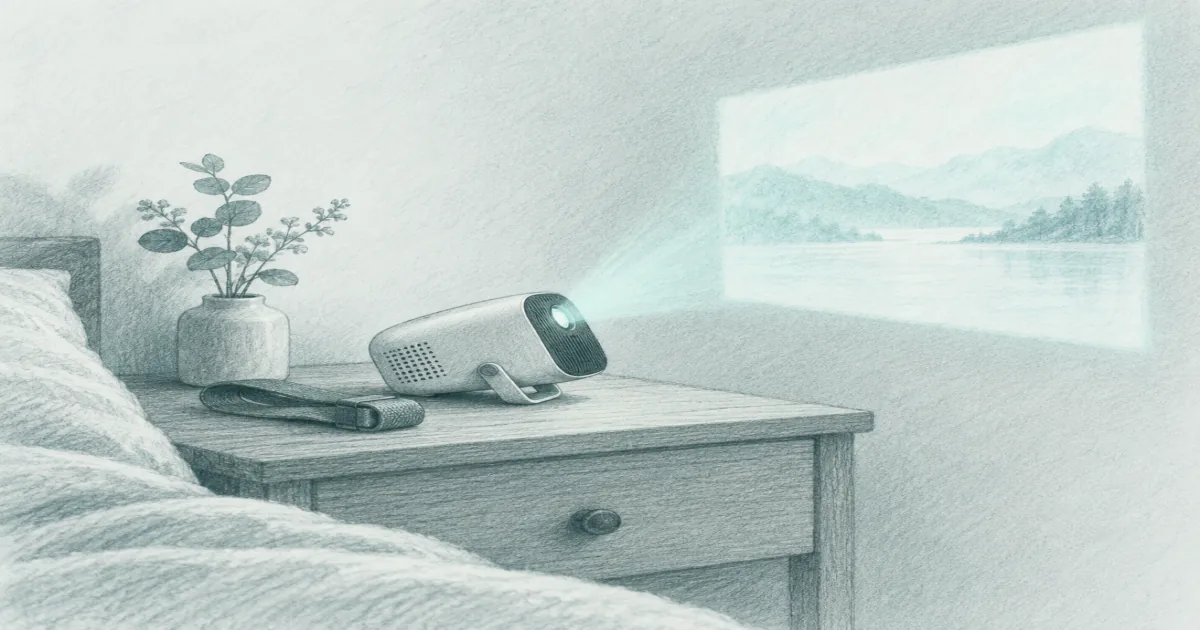
The gimbal stand is the feature that earns it the top slot. It rotates through 180 degrees and holds its angle, so you can set it on a nightstand and watch from bed with no tripod. The TOF auto focus and auto keystone reframe the picture in a couple of seconds when you swing it from the wall to the ceiling, which no flat mini here can do.
The USB-C PD input is the other standout. A 65W laptop charger or power bank runs it, so it works on a patio, in a dorm, or anywhere the nearest outlet is inconvenient. The trade is weight and fan noise: at about 2.6 pounds it is heavier than the travel picks, and the cooling fan is audible in quiet scenes.
Check the Aurzen Roku TV D1R air on Amazon for the current price.
Best under $100: HAPPRUN Roku TV Mini Projector
The HAPPRUN Roku TV Mini is the value pick for most rooms because it removes the usual friction for about $100. The Roku platform is built in, not sideloaded, so the apps, the search, and the remote all work the way they do on a Roku TV. You are not buying a projector and a streaming stick and then finding two remotes.
The picture is native 1080p, which separates it from the cheaper 720p minis. Text in a menu and details in a bright scene hold together better, and the auto vertical keystone squares the image when the projector is not perfectly level. The body is small enough to sit on a nightstand and light enough to move without planning.
The trade is brightness and focus. At this size and price the output is modest, so ambient light is the enemy and a dark room is the friend. Focus is a manual wheel, which is quick once you learn it but not as effortless as the auto-focus units up the price ladder. Neither is a dealbreaker for a bedroom or a dorm.
Check the HAPPRUN Roku TV Mini on Amazon for the current price.
Best under $50: Magcubic HY300PRO
The Magcubic HY300PRO is the value pick and the most fun one here. Its 180 degree rotating stand lets it aim at a wall, a ceiling, or the side of a tent, which is a trick the flat projectors cannot do. That makes it a natural fit for a bedroom where the only open surface is above the bed.
It runs Android with the popular apps built in, plus dual-band Wi-Fi and Bluetooth 5.2, so you can pair a speaker or headphones. At this price the panel is native 720p, and the brightness is enough for a dark room but not for a lit one. The chip handles apps fine, though it can get sluggish when it runs hot for a long stretch.
For the money, that is a fair trade. It is a second-room projector, a gift, or a first projector for a kid, not a replacement for a living-room TV. Treated that way, it is hard to beat at this price, especially when a deal is running.
Check the Magcubic HY300PRO on Amazon for the current price.
Best for travel: Aurzen Roku TV E1R
The Aurzen Roku TV E1R is the travel pick because it is built around portability without giving up the smart platform. Under one pound, with the strap attached and a stand that folds out of the body, it fits in a backpack next to a laptop. Official Roku TV is onboard, so the interface and apps are the ones you already know.
The short throw ratio is a real advantage in small rooms. It fills a wall from a few feet back, which means it works on a desk or a shelf where a standard projector would need the whole room. Auto vertical keystone and electronic correction handle the geometry, and focus is a manual wheel.
The trade is the panel. Native resolution is 720p and rated brightness is 160 lumens, so it is a dark-room projector by design. It is not the pick for a bright living room or fine detail, but for a dorm, a bedroom, or a trip, the size and the Roku platform are the whole point.
Check the Aurzen Roku TV E1R on Amazon for the current price.
Portable projector or a small TV?
A small TV wins on brightness and convenience. It works with the lights on, it never needs a dark room, and it turns on instantly. If your space gets daylight and you mostly watch during the day, a 32 to 43 inch TV is the simpler answer, and it costs about the same as these projectors.
A portable projector wins on size and flexibility. It can make a 70 inch picture in a room where a TV that big would never fit, and it can move from the bedroom to the backyard. The catch is the room. A projector needs darkness, and the darker the room, the better the picture looks.
The honest split is use case. Daytime TV with the lights on points to a small TV. Night movies, a ceiling screen, or a picture that travels points to a projector. If you want both, the projector plus a cheap light-blocking curtain is still less than a large TV.
How to get a bigger picture in a small room
Start with the wall, not the projector. A flat, light wall or a pull-up screen gives you the most for free. Paint a patch matte white if you want a permanent screen, and skip glossy finishes, which throw a hot spot right where you sit.
Set the throw distance next. Most minis want six to ten feet for a 60 to 80 inch image, and short-throw units need only a few feet. Measure the room before you buy, because the distance you have decides the size you get.
Control the light last, and treat it as part of the purchase. A cheap blackout curtain behind the screen wall does more for picture quality than the next model up. Once the room is dark, even a 160 lumen mini looks surprisingly good at 60 inches.
Who should skip a portable projector
Skip it if you watch with the lights on. No mini in this price range beats ambient light, and a tired picture is worse than a smaller TV. Pick a TV if the room cannot be darkened.
Skip it if you want one screen for everything. A projector is a second screen or a travel screen, not the family TV that handles the news, the game, and the kids' shows all day. Brightness and bulb life both favor a TV for that job.
Skip the cheapest unit if you care about sharp text. Native 720p is fine for video and soft on small text, so a menu-heavy or desktop use case wants the 1080p Aurzen or HAPPRUN. Spend the extra and skip the squinting.
Common questions
Can I use my phone with a portable projector? Yes, over HDMI with the right adapter, or by casting to a built-in Roku or Android platform. Casting is easier for streaming apps, and HDMI is more reliable for local video, so keep the adapter in the bag.
How long do these projectors last? The LED light sources are rated for tens of thousands of hours, which is years of movie nights. The fan and the power supply are the parts that age first, so keep the vents clear and give the unit a break between long sessions.
Do they work with a game console? Yes over HDMI, and the picture is big and fun. The input lag on budget minis is higher than a TV, so keep the competitive games on the TV and the party games on the projector.
Will a mini projector replace my TV? Not for most people. It is best as a second screen for movies and nights, where the big image matters and the lights are off. Keep the TV for daytime and everything else.
Frequently Asked Questions
Are portable projectors worth buying?
Yes, if you want a big picture in a room where a TV does not fit, and you can control the light. A modern mini projector with a streaming platform built in is genuinely easy to live with. The honest limit is brightness: in a bright room, no mini in this price range looks good.
What is the best portable projector to buy?
For most people, the Aurzen Roku TV D1R air is the best buy. It is native 1080p, Roku is built in, the gimbal stand and auto focus handle setup, and it can run from a USB-C power bank. If you want to stay under $100, the HAPPRUN Roku TV Mini is the value pick.
Which is the best portable projector for home use?
The Aurzen Roku TV D1R air is the best home pick because it has the sharpest picture here and behaves like a small smart TV. It runs the Roku apps people already use, the gimbal stand handles ceiling and wall angles, and the 5W speakers are loud enough for a bedroom. For a dorm or a shared apartment on a tighter budget, the HAPPRUN is easier to justify.
What is the best portable projector available right now?
For a bedroom, the Aurzen Roku TV D1R air or the HAPPRUN Roku TV Mini. For travel, the Aurzen Roku TV E1R. For the lowest price, the Magcubic HY300PRO. All four stream without an extra stick, and all four want a dim room, which is the trade you make at these prices.
Do portable projectors need Wi-Fi?
Yes for streaming, and once during setup to sign into an account. You can also feed them over HDMI from a laptop, console, or phone if there is no network. That is the better path for camping, where Wi-Fi is usually the thing you left behind.
Can a portable projector run on a battery?
The Aurzen Roku TV D1R air can run from a 65W USB-C power bank, which makes it the easiest of these to use away from an outlet. Most of the others do not have a battery, so plan on a wall outlet or a power bank that matches the unit's power input. Check the input voltage before you pack it.
How big a picture can a mini projector throw?
The specs often claim 100 to 200 inches, but brightness is the real limit. A mini projector looks best between about 40 and 80 inches in a dark room. Push it to 150 inches and the image gets dim and soft, no matter what the box says.
Do you need a screen for a portable projector?
No, but a flat white or light gray wall does most of the work. If you want a sharper picture, a pull-up or fixed-frame screen helps, and our projector screen guide covers the sizes worth buying for a small room.