Best Center Channel Speaker (2026): Two Picks for Clear Dialogue
Soundbars and speakers
Two center channel speakers that fix the one thing every home theater needs, clear dialogue, split by sound and system: a sensitive horn-loaded Klipsch that fits a shelf, and a warm Polk that pairs with Polk speakers.
Our picks
The best center channel speaker for most systems is the Klipsch R-52C. It is the pick we suggest when dialogue is the problem and you want it solved with one purchase. The Polk Audio T30 is the better choice when your other speakers are Polk, or when a horn's brighter top end is not your taste.
Dialogue is mixed to the center channel in almost every movie and show. That makes the center the hardest-working speaker in the room and the first upgrade worth making. If you already run a receiver and a pair of fronts, adding a center will change more than any other purchase at this price.
A center channel is a passive speaker, so it needs an amplifier to run. Our AV receiver guide covers the other half of the purchase, and the soundbar and speaker guides page has the rest of the system picks. If you would rather keep it to one box, the soundbar under $500 guide is the shortcut.
Why the center channel decides dialogue
Every mix sends voices to the center. Explosions and music pan across the other channels, but the conversation stays in the middle, which means the center speaker carries the part you cannot miss. When that speaker is weak, you ride the volume all night.
A center has to do two jobs well. It has to stay clear at low volume, so quiet scenes are intelligible without a fight, and it has to hold up when the soundtrack gets loud without letting voices get buried. Sensitivity and cabinet design decide both.
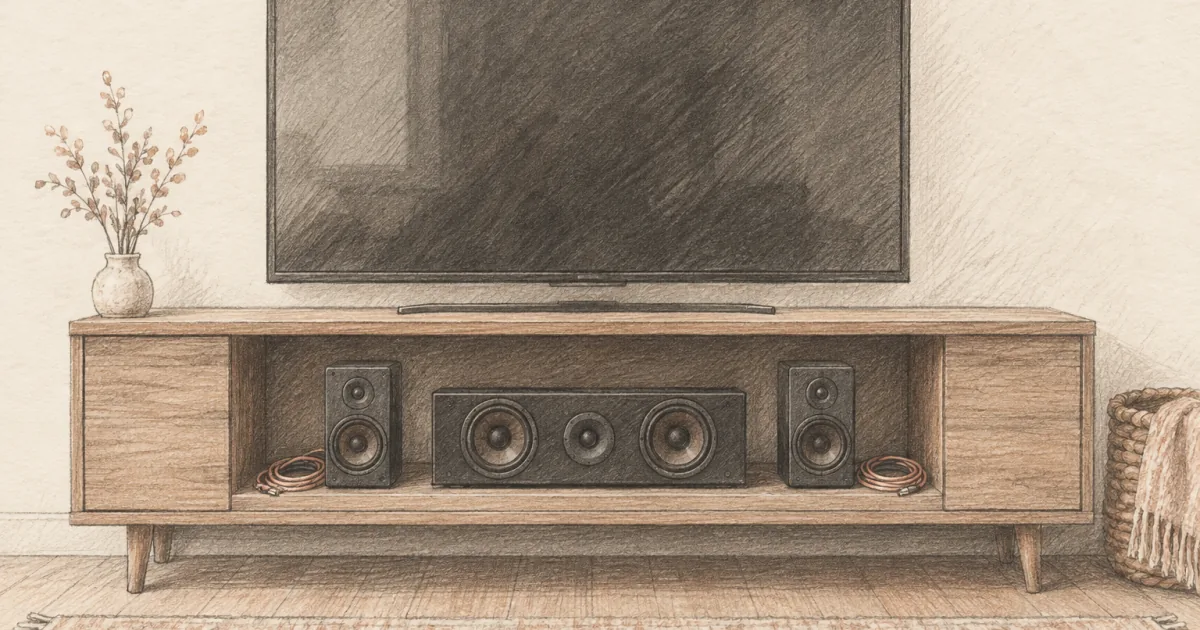
Placement matters as much as the speaker. A center crammed into a closed cabinet or aimed at your knees will sound muffled no matter how good it is. Give it open air, keep it near ear height, and angle it toward the seat.
The best overall: Klipsch R-52C
The Klipsch R-52C is the best center channel for most systems because it does the one job that matters and does it efficiently. It uses a 1 inch aluminum tweeter behind Klipsch's 90 by 90 degree Tractrix horn, paired with dual 5.25 inch spun-copper woofers. The horn aims the high frequencies at the listener instead of bouncing them off the walls.
The efficiency is the practical advantage. At 95dB sensitivity, the R-52C needs far less power than most speakers to reach the same volume, which means an entry-level receiver is enough. That is a real benefit if you are building a system on a budget.
The closed-back design is the second win. With no rear port, it can sit in a shelf or a built-in without choking the bass, which is exactly where most people put a center. The magnetic grille pops off for cleaning or for showing off the copper drivers.
The trade is the horn sound and the width. Horn-loaded tweeters are detailed and forward, which some listeners love for movies and others find bright with music. Pair it with a neutral receiver if you are sensitive to that, and measure your shelf first, because 18.75 inches is a wide speaker.
Check the Klipsch R-52C on Amazon for the current price.
Best for Polk systems: Polk Audio T30
The Polk Audio T30 is the right center when your front speakers are Polk, or when you want a softer top end. It uses dual 5.25 inch Dynamic Balance woofers and a 1 inch silk-dome tweeter, and it is engineered to match the Polk T-series bookshelf and tower models.
Timbre matching is the reason to choose it. When the center shares the same tonal character as the left and right speakers, sound that pans across the front stays even instead of jumping in tone as it crosses the screen. If you own Polk speakers, that consistency is worth more than a spec advantage.
It is a 6 ohm speaker rated at 100 watts, so it works with normal receivers. Polk's own forum confirms the 6 ohm rating, which means your amp will draw a little more current than with an 8 ohm speaker. Most home theater receivers handle this without trouble, and the payoff is more output for the same volume knob.
The trade is the cabinet. At 19 inches wide and 11.45 pounds, the T30 is a substantial speaker, and reviewers often point out that it is larger than they expected and has no wall mount. Give it a real shelf with open air in front, and it rewards you with clear dialogue.
See the Polk Audio T30 on Amazon for the current price.
Horn or dome: which center channel sound is for you
A horn tweeter is efficient and directional. It sends treble toward the seat and stays clear at low volume, which is why Klipsch centers are popular for movies. The flip side is a forward top end that some listeners find bright, especially with music.
A dome tweeter is warmer and wider. The Polk silk dome spreads high frequencies more gently, which suits mixed music and movies and pairs well with other dome speakers. It trades a little efficiency for a more relaxed tone.
The safest way to choose is to match what you already own. If your front speakers are Klipsch, a Klipsch center blends best. If they are Polk, take the Polk. If you are starting fresh, decide whether you want forward detail or a warmer voice, then build the rest of the system around that.
How to place and power a center channel
Set the center at ear height and aim it at the seat. If it has to sit below the screen, tilt it up toward your ears. If it sits above, tilt it down. The driver wants a clear line to your head, not to the wall behind you.
Keep it out in the open. A center inside a closed cabinet sounds muffled and loses its dialogue advantage. If you must use a shelf, leave the front of the speaker flush with or slightly proud of the shelf edge, and remove the door if there is one.
Give it enough amplifier. Both speakers here are passive, so they need a receiver channel. Match the impedance, run the receiver's calibration routine, and set the center level so voices sit level with or slightly above the fronts.
Keep the wire tidy. One wire pair from the receiver's center output is all you need, but leave slack before you dress it along the wall. Cutting the run close is the mistake people regret when they move the cabinet.
Who should skip a center channel speaker
Skip it if you do not own a receiver. A passive speaker needs an amplifier, so start with the receiver and fronts, then add the center. A soundbar is the faster route if you want one box and no wiring.
Skip it if you watch alone with headphones. The center channel exists to anchor dialogue for a room, and a headphone setup already does that. Put the money into the headphones or a better subwoofer instead.
Skip the Polk if your system is Klipsch, and skip the Klipsch if you know you dislike horn treble. Timbre matching is free consistency. Buying across brands is not wrong, but it rarely sounds as even as staying in the family.
Common questions
Do I need a center channel with a soundbar? No. Soundbars have their center channel built in, so a separate center would be redundant. This guide is for component systems with an AV receiver and separate front speakers.
Can I use two center speakers? No. A receiver has one center output, and two speakers on that channel cause comb filtering that smears voices. Use one center and put the money into better fronts if you want more output.
Will a center channel help music? It helps multichannel music and concert films, where vocals are mixed to the center. For two-channel stereo, the center usually stays silent unless you engage a surround mode, which some receivers do well and others do not.
How do I know my receiver can drive a center? Check the impedance rating and the power per channel. Both speakers here are easy loads, and any receiver rated for 6 or 8 ohms will run them. If your receiver runs hot or shuts down, that is a sign it is working too hard.
Frequently Asked Questions
Is a center channel speaker worth it?
Yes, if you watch movies or shows. The center channel carries almost all dialogue, so it is the speaker that decides whether you understand what you are watching. If you already own a receiver and front speakers, adding a center is the biggest single upgrade you can make.
What is a good budget center channel speaker?
The Klipsch R-52C is the best value for most rooms. Its 95dB sensitivity means a modest receiver drives it easily, and its closed-back cabinet fits a shelf. If your other speakers are Polk, the Polk T30 is the better match and often costs less.
Can any speaker be a center channel?
Technically yes, but a bookshelf laid on its side is a compromise. A dedicated center has a horizontal driver layout and a cabinet tuned for the job, so voices stay anchored to the screen instead of smearing to one side.
What is the best center channel speaker under $1000?
For most rooms, you do not need to spend near that. The Klipsch R-52C and the Polk T30 both deliver clear dialogue well under $300. Above that you pay for bigger cabinets and more output, which only helps in a large room.
Should a center channel match my front speakers?
Matching the brand and series helps the most, because voices and effects share the same tone when sound pans across the front. It is not mandatory, but if you own Polk speakers, a Polk center will blend better than a horn-loaded Klipsch.
What impedance is a center channel speaker?
The Klipsch R-52C is 8 ohms and the Polk T30 is 6 ohms. Both work with normal home theater receivers. A 6 ohm speaker asks more current from the amp, so check that your receiver is rated for it or leave it in the default setting if the amp runs cool.
How do I wire a center channel speaker?
Run one speaker wire pair from the receiver's center output to the speaker, red to red and black to black. Keep the run away from power cables where you can, and make sure the wire is long enough before you dress it along the wall.
Where should a center channel speaker sit?
As close to the screen as possible, at the same height as your ears, and angled slightly up if it sits low. Above the TV is a compromise, and inside a closed cabinet muffles it. Open air in front of the driver matters more than a small height difference.