Best Subwoofer for Car (2026): 3 Packages Ranked by Job
Soundbars and speakers
Three car subwoofer packages that cover the three real jobs, a single 12 for most cars, a dual 12 for deep bass, and a slim under-seat sub for trucks and tight cabins, plus the electrical math nobody mentions.
Our picks
The best subwoofer for most cars is the Skar Audio single 12 inch package, and the reason is not the driver, it is the bundle. Enclosure, amplifier, and wiring ship in one box with the impedance already matched, which removes the two places first-time buyers go wrong: the box and the amp. The dual 12 inch package is the pick when you want the sub-30 Hz octave back. The under-seat powered sub is for tight cabins and trucks.
Start with the soundbar and speaker guides if you are still deciding how far to take the audio in this car, or read the best soundbar under $500 guide if the vehicle is not the room you care about. If you are building a listening room instead, our wireless surround guide and the AV receiver guide cover the home side.
What a car subwoofer package actually includes
A loaded enclosure package is the shortest path to bass, but the word "package" hides a few parts. Knowing which parts are in the box tells you what still has to be bought before the car is making noise.
What comes in a loaded enclosure package
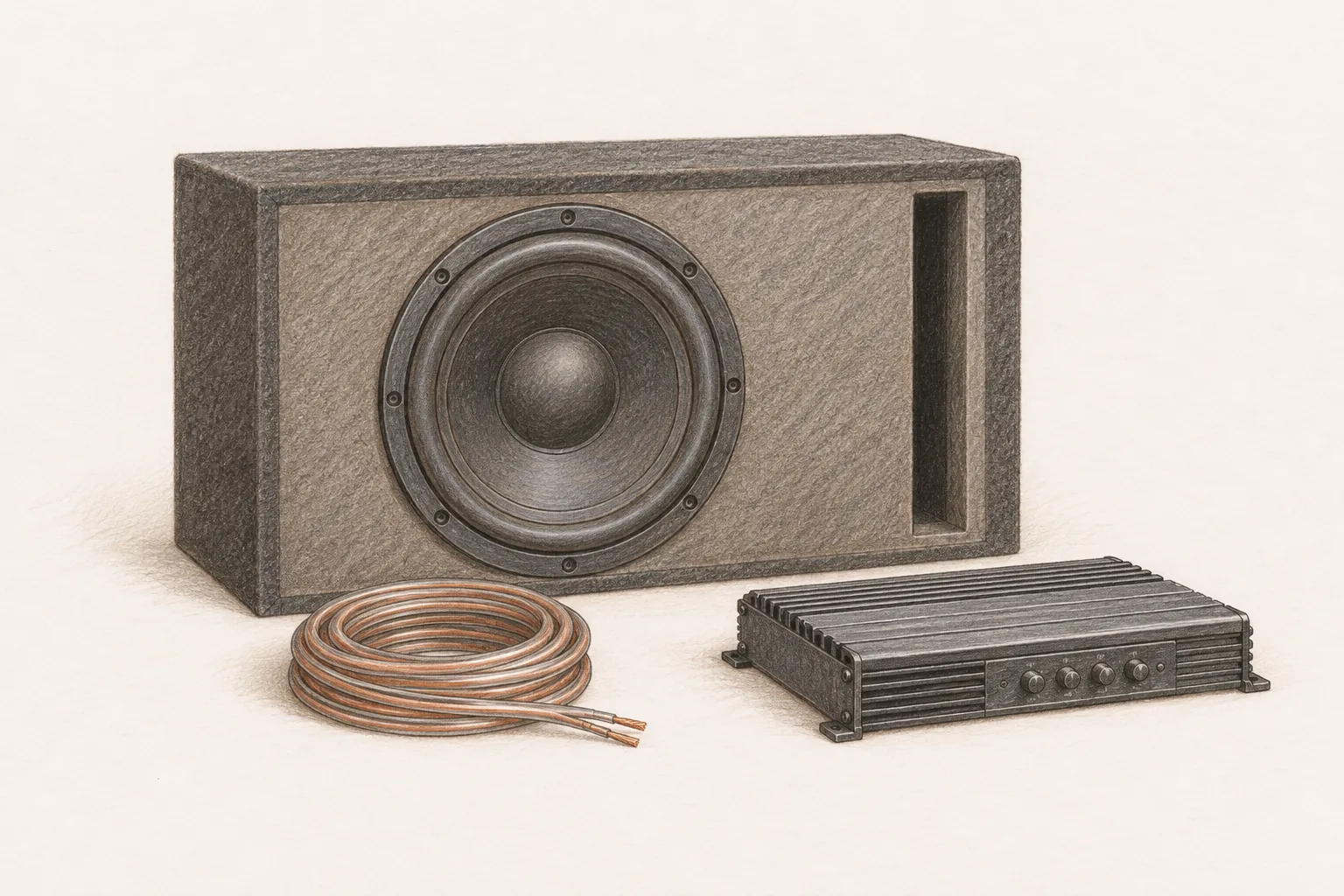
A loaded enclosure arrives with the woofer already mounted and wired inside the cabinet, so the ohms are set for you. The Skar single 12 inch package lands at a 1 ohm final load at the terminals, which is the configuration a class D monoblock likes. You get the box, the subwoofer, the amplifier, and a 4 gauge wiring kit. What you do not get is the fuse holder upgrade, extra speaker wire, and the patience to run power through a firewall.
What a factory radio still needs
Factory head units rarely have a dedicated subwoofer output, so the amplifier needs a signal from somewhere. A line output converter taps the rear speaker wires and turns that into RCA level signal. It is the part most first-time buyers forget, and it shows up in forum threads as the reason a new sub is quiet or only works when the fade is set to one side. If your radio already has a sub out, skip it.
Why the wiring kit is the part people replace first
The included kit is built to a price, and owners notice. Reviewers of the Skar packages call the RCA cables and the power and ground wire the low quality parts of an otherwise good bundle, and a shop technician who unwrapped a Skar kit described the "16 gauge" speaker wire as feeling closer to 20 gauge. The fix is cheap: replace the RCA pair and the speaker runs if you hear alternator whine or thin signal.
What size subwoofer fits your car?
A single 12 inch in a vented box fits most sedans and small SUVs, a dual 12 needs a full trunk, and a 10 inch under-seat box fits anywhere a seat has 3 inches of clearance. Measure the opening and the depth before you choose.
10 inch vs 12 inch: what the size actually changes
The diameter decides how much air the driver can move, not how good it sounds. A 10 inch woofer in a well-built sealed box can sound tighter and faster than a 12 in a loose vented cabinet. In the same box volume, the 12 goes lower and louder. If your music leans on kick drum and bass guitar, a 10 is plenty. If you want the low synthesizer notes and movie effects, buy the 12.
Measure the trunk opening, not the trunk
A dual 12 inch box can be 40.75 inches wide and 22 inches tall, which clears most sedan trunks on paper and then jams on the rear lip. Measure the narrowest point of the opening, then measure the box. Also check the height against the trunk lid hinge arms, which travel down into the space when the lid closes.
How much clearance does an under-seat sub need?
The 10 inch powered box here is 13.5 inches long, 10.2 inches wide, and 3.1 inches thick. Look under the seat for the seat rails, the ventilation duct, and the wiring for power seats. If the seat has a motor, the mechanism usually needs more clearance than the cushion suggests.
Best overall: Skar Audio single 12 inch package
The Skar Audio single 12 inch package is the pick for most cars because it removes the guesswork without asking you to become an installer. The SDR-1X12D2 enclosure comes loaded and wired, the RP-800.1D monoblock is matched to it, and the 4 gauge kit has everything but the fuse holder. You bolt the box down, run power, ground, and signal, and you are done.
The output is honest for the money. 600 watts RMS and 1,200 watts peak from a single 12 inch driver is more than a factory system can imagine, and because the box is vented and quite efficient, it sounds loud before the amplifier works hard. That efficiency is also why the package does not demand a charging system upgrade the way a bigger build does.
The trade is a specific one. A pre-fab vented box tuned for output does not reach the lowest octave, and owners of this exact box say so plainly: one called it "not bad" but added that if you want deep bass, plan on a different box. The other trade is weight, at 71 pounds shipped, so plan a second pair of hands.
Check the Skar Audio single 12 inch package on Amazon for the current price.
Best for deep bass: Skar Audio dual 12 inch package
The dual 12 inch package is the step up for anyone who wants the bottom octave and has room for it. Two SDR-2X12D4 drivers in a vented cabinet rated from 32 Hz, driven by the RP-1200.1D at 1,200 watts RMS, is roughly double the air movement of the single-12 kit. That is the difference between hearing a kick drum and feeling a bass line.
It is also the package that asks more of the car. Two 12s at 1,200 watts RMS pull enough current that stock wiring starts to show its limits, which is where headlight dimming and dash light resets come from. The fix is not a mystery part, it is a bigger ground, a capacitor, and in some cars an alternator that can actually deliver the current. Plan that before you plan the box.
The trade is that this is a system, not an upgrade. It needs a full trunk, a solid mount, and some sound deadening before it sounds good rather than rattly. In a small car it is simply the wrong tool, and the under-seat pick below is the right one.
See the Skar Audio dual 12 inch package on Amazon for the current price.
Best for tight space: the slim under-seat powered sub
The under-seat powered sub is for the driver who wants the music fuller, not louder. It is a single 10 inch driver in a cast aluminum box with the amplifier built in, rated at 220 watts RMS against an 800 watt peak number. The fuse is the honest figure to look at, and 220 watts of real output is a meaningful upgrade over door speakers in a small cabin.
Installation is the reason to pick it. It accepts low level RCA and high level speaker inputs, so a factory head unit can drive it without a separate amplifier, and the wired remote controls gain and bass from the front seat. In a truck, a hatchback, or a car where the spare tire well is full, hiding the whole thing under a seat is the only layout that works.
The trade is its character. A box that size cannot move the air a 12 can, and these designs typically peak somewhere around 55 to 65 Hz, which sounds boomy instead of deep. If you want the low octave, this is not the part. If you want a factory stereo to stop sounding thin, it is exactly the part.
Check the under-seat powered sub on Amazon for the current price.
How much power can your car's electrical system feed?
A 600 watt RMS amplifier draws roughly 45 to 60 amps at full output on a 14.4 volt charging system, which most stock alternators cover. Step up to 1,200 watts RMS and you are asking for twice that, which is where dimming lights start.
The fuse is the honest power number
Fuse ratings are the amplifier maker's own limit, and they are closer to reality than a peak figure printed on a box. A 25 amp fuse caps a powered under-seat sub at roughly 300 watts of input, which lines up with its 220 watt RMS rating. When a listing advertises 800 watts and the fuse says 25 amps, the fuse is the number to trust.
Grand RMS watts vs peak watts vs "max power"
Peak figures are marketing, RMS is work. Class D amplifiers are roughly 80 percent efficient, so 600 watts of output asks for about 750 watts of input, or around 52 amps at 14.4 volts. That is the math behind the rule that one 12 inch sub is a stock electrical system job and two 12s is an upgrade discussion.
What dimming headlights actually mean
Dimming lights at every bass hit mean the amplifier is pulling current faster than the charging system can replace it. It does not damage the sub, but it stresses the alternator and the battery. The usual order of fixes is a larger ground cable, then a capacitor near the amplifier, then a higher output alternator if the first two are not enough.
What does it cost to add a subwoofer to a car?
The subwoofer package is the biggest line item, but a complete install usually adds a line output converter, extra speaker wire, sound deadening, and either your own weekend or a shop's labor. Plan the extras as a small percentage of the package price.
Who should skip a powered under-seat sub
Skip it if you want to feel bass rather than hear it. A 3.1 inch box with 220 watts of real output cannot pressurize a cabin the way a 12 inch driver in a vented box does, and buyers who expect otherwise end up disappointed.
Skip it if your music is the point and your trunk is free. A single 12 inch package costs more than the under-seat box but delivers an octave more low end and a much bigger dynamic range. The only reason to choose the flat box is space or a lease car you have to give back unchanged.
Skip all three if you are not ready to run a power cable. Every subwoofer here needs a fused positive run from the battery, a solid ground, and a signal path. If that is not a project you want, a soundbar for the house is a better use of the money than a half-installed sub.
Common questions
Will a subwoofer make my door speakers sound better? No, it will make them sound smaller. A sub takes over the lowest notes, which frees the doors to play cleaner, but thin factory speakers still sound thin. Plan on replacing front speakers if the whole system is factory.
Can I run two subwoofers on one amplifier? Yes, if the amplifier is stable at the combined impedance and rated for the total RMS. Two dual 4 ohm drivers can be wired to a 1 ohm final load, which many monoblocks support. Check the amplifier's minimum impedance before you wire anything.
Does a bigger subwoofer need a bigger alternator? Sometimes. Up to about 600 watts RMS, most cars are fine once the ground and battery terminals are clean. Above 1,000 watts RMS, plan on a charging system review, and a capacitor if dimming shows up at idle.
Frequently Asked Questions
What is the best subwoofer for a car?
For most cars, the Skar Audio single 12 inch package is the best all-round answer. It bundles a loaded vented enclosure, a matching 800 watt monoblock amplifier, and a 4 gauge wiring kit for one price, and 600 watts RMS is enough output for a sedan or small SUV without touching the alternator.
Are subwoofers worth it in a car?
Yes, if your factory system sounds thin and you want to hear bass lines and low effects. A subwoofer adds the octave door speakers cannot reproduce. It is not worth it if you only want louder mids, or if you are not prepared to run a power cable from the battery.
What sounds better, 10 or 12 inch subs?
Size matters less than the box. A 10 inch driver in a correctly tuned sealed box can sound tighter than a 12 in a cheap vented box, while a 12 moves more air and reaches lower in the same cabinet volume. Pick the box and tuning first, then the diameter.
Can I just put a subwoofer in my car?
Only if the box has a built-in amplifier and accepts speaker level inputs. Separates, meaning a passive sub, an enclosure, and a monoblock amp bought separately, also need a wiring kit, a fuse holder, and usually a line output converter so a factory radio can feed the amplifier.
Will a subwoofer drain my car battery?
A 600 watt RMS setup draws roughly 45 to 60 amps at full output, which most stock alternators handle. Two 12s at 1,200 watts RMS is where headlight dimming starts, and that is the point to think about a capacitor, an upgraded ground, or a higher output alternator.
Do under seat subwoofers sound good?
They sound good for what they are: bass fill for a factory stereo in a tight cabin. Expect output from about 45 Hz upward, with a peak around 55 to 65 Hz. They will not reproduce the lowest movie effects the way a 12 inch sub in a vented box can.
Where should a subwoofer box go in a trunk?
Facing the rear of the car, a few inches back from the trunk wall, is the usual strong starting point. Bass reflects off the rear wall and comes forward, so firing the woofer at the tail lights often gives more output at the driver's seat than firing it into the cabin.
Do I need a separate amplifier for a car subwoofer?
Not if the sub is a powered model with the amplifier built into the enclosure. Passive subs and loaded enclosures without electronics do need one, and the amplifier has to match the sub's impedance and RMS rating. The two Skar packages here include the matching amplifier.